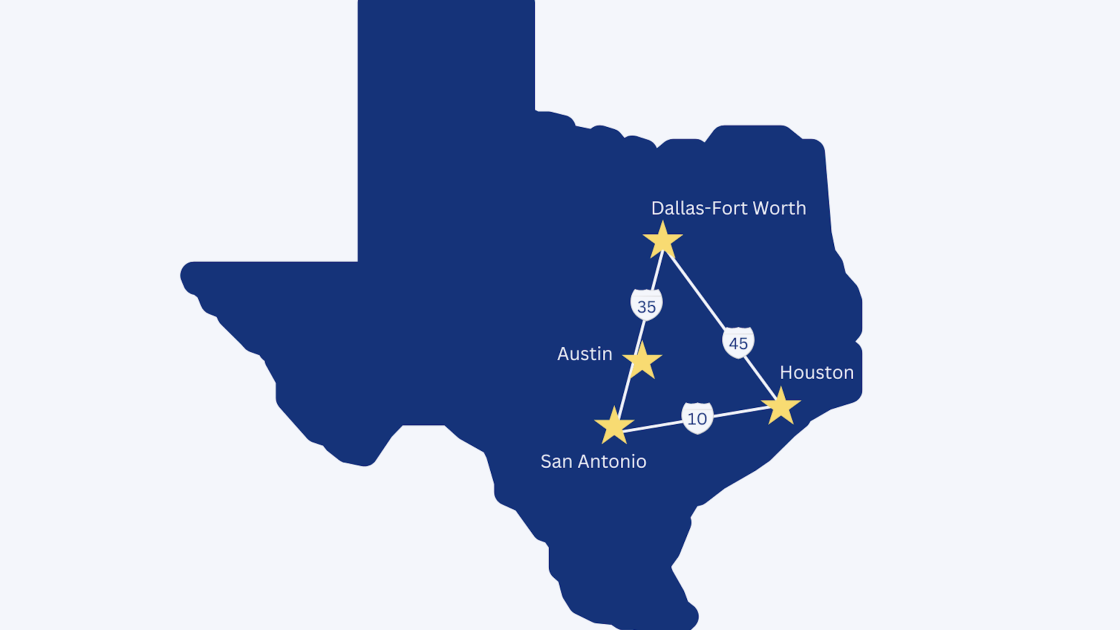
The Texas Triangle — the corridor connecting Dallas-Fort Worth, Houston, San Antonio, and Austin — is one of the fastest-growing regions in the country, with the population projected to approach 25 million by 2035. Demographers have begun calling it a “megaregion,” reflecting its status as one of the country's major growth hot spots. Most institutional capital chasing that growth defaults to the same playbook: build more rental housing to meet demand. But for investors with a more private-equity-like time horizon, ground-up boutique condominium development in the Triangle's secondary and tertiary markets is arguably the more attractive opportunity today — for reasons that have less to do with the product itself than with timing, geography, and structure.
A Multifamily Pipeline That No Longer Exists
The multifamily story of the last several years was defined by oversupply. Developers across Texas broke ground on tens of thousands of units during the 2021–2022 boom, and the market has spent the past two years absorbing that wave. Many of those developers now find themselves offering concessions and cutting rents, which has compressed returns for investors across numerous Texas submarkets. That glut is now working its way through the system, and new multifamily starts have slowed dramatically as a result of market-specific oversupply, tighter construction financing, and rising land costs.
In our estimation, that pullback represents a clear opportunity. With effectively no active multifamily pipeline across much of the Triangle's secondary and tertiary cities and towns, the next housing cycle is arriving with far less competing supply than the last one. Capital that positions itself now, ahead of the next wave of institutional multifamily capital returning to the market, is well situated to catch the recovery rather than compete inside a glutted one.
The Time-Horizon Mismatch
Multifamily is fundamentally a hold-and-operate asset. Even in a favorable environment, the typical multifamily investment cycle runs anywhere from seven to ten years or longer once a developer accounts for entitlement, construction, lease-up, and stabilization ahead of a sale or refinance that actually pencils. That timeline works for pension funds, REITs, and other permanent-capital vehicles, but it's often a poor fit for private investors who prefer a defined entry and a defined exit.
A cautionary pattern from the last cycle is worth noting here. Over roughly the past decade, particularly across the South and Southwest, a wave of “merchant builders” entered the multifamily space with little operating experience and no intention of continuing to own what they built over the long haul. Their model was to deliver a 200- to 300-unit rental community, lease it up just enough to get it stabilized, and then flip it to an institutional buyer as quickly as possible. To make that story sell, many of these projects were dressed up with elaborate amenity packages, including pools, spas, dog spas, cold plunges, golf simulators, etc., while the underlying building systems were value-engineered down to the minimum: thin-gauge vinyl windows, EIFS exterior systems with well-documented long-term moisture issues, particleboard cabinetry, and unconditioned corridors, among others. None of that shows up during a lease-up tour, but it becomes quite evident in the capital expenditure schedule a few years later, often after the asset has already changed hands to an institutional owner that is now managing operating and durability costs it didn't originally underwrite. This dynamic represents a clear structural risk worth understanding, whichever side of the multifamily trade an investor is considering.
Condominiums solve the time-horizon mismatch directly. Because units are sold to individual owners rather than leased and held, a boutique condo project typically cycles from land acquisition to full capital return in three to five years, far closer to a merchant-build model than a buy-and-hold one, but without the durability trade-offs described above, since the building has to satisfy individual owners and a homeowners' association for the long haul, not just a lease-up appraisal. Presales during construction accelerate the timeline further, converting future revenue into present certainty, proving out demand before full capital is at risk, and reducing the amount of capital exposed to market risk at any given moment. For an investor underwriting to an IRR rather than a cap rate, that shorter duration is often the single biggest lever available: capital doesn't merely earn a return, it is actually returned to investors, with a healthy ROI, so it can be redeployed quickly.
Small and Mid-Sized Cities and Suburbs Over Trendy Big Cities
The instinct for many investors is to chase the recognizable, if not trendy names like central Austin, Dallas, or Houston. Essentially the urban core of very large, fast-growing markets. But the more interesting opportunity in the Triangle right now sits in the smaller cities, suburbs, and towns strung along corridors like I-35: places experiencing outsized population and job growth without outsized competition for development sites. What's notable about the geography of these municipalities is that they sit directly “on” the beaten path, along major highway networks, rather than being dozens of miles into the interior.
Roughly seven in ten Texans live within the Texas Triangle, which, according to the Texas Urban Planning Agency, puts the region's population at around 22.55 million against a statewide total of roughly 32 million. The four largest cities, Houston, San Antonio, Dallas, and Fort Worth, account for a little over 6 million of that; add Austin and the major-city total is closer to 7 million. That leaves an estimated 15+ million people living in the small and mid-sized cities, suburbs, and towns arrayed between the big four; a population comparable to a mid-sized European country. While the industry has clearly overbuilt Class A rental supply in Texas' major cities, for-sale condominiums have not had the same experience. And in the smaller markets throughout the Triangle, the marketplace is even more lopsided. The U.S. Census Bureau counts 782 Texas cities with more than 1,000 residents, a substantial majority of which are actively growing, driven by outer-ring suburban expansion around the major metros and by the continued shift toward both remote and hybrid work.
A few dynamics make these markets structurally attractive for condos specifically:
- The product is still novel. In most of these towns, condominiums are essentially unknown as a housing type. Where a big-city market is saturated with rentals and comparable for-sale product, and buyer attention is split across dozens of competing projects, a well-designed condo building in a growing secondary market may very well be the only option of its kind, commanding the attention, pricing power, and community identity that comes with being a first mover.
- Demographic needs on both ends of the age spectrum. A growing population of empty nesters living in suburban single-family homes has rarely had the option to downsize locally, as smaller homes and condo units have never really been offered in most small Texas towns. At the same time, the same tech and industrial growth reshaping the big four cities is creating jobs for young professionals in small and mid-sized cities as well; a buyer pool with nowhere to go but a single-family home or an out-of-market rental.
- Condos solve an affordability gap. In markets where new single-family homes have climbed out of reach for many buyers, a condo offers a meaningfully lower price point for ownership, often the only new-construction ownership option under a given threshold. That widens the buyer pool considerably: young professionals, downsizers, and relocating workers who want to own but can't or won't buy a full house on a lot.
- A “lock-and-leave” lifestyle, paired with a strong preference for ownership. Many younger, single buyers don't want to own a home yet, but rising tech-sector wages are increasingly pulling them toward ownership over renting, sooner than in past generations. For empty nesters the pull toward ownership is even stronger. It is also common to hear from suburban buyers looking to trade a house for single-level, lock-and-leave living. Additionally, older buyers in particular tend to view renting as a poor long-term investment and want to own, not lease, their next home.
- Entitlements move faster. Smaller municipalities are frequently under-resourced in terms of housing stock and eager to see quality infill development happen. Rather than working through the crowded, often adversarial approval process typical of a major metro like Austin, projects in these municipalities are frequently welcomed by city staff and councils who see a well-designed condominium building as exactly the kind of tax base and downtown vitality they've been trying to attract. That translates into faster, more predictable zoning and permitting timelines, shortening the development cycle further and reducing one of the biggest sources of cost and schedule risk in any ground-up project.
- A rental glut is colliding with stretched infrastructure. Many smaller cities have been overbuilt with new Class A rental apartments, just like the big cities, and that oversupply, combined with sprawling single-family subdivision growth, is straining local water, sewer, and power infrastructure. Utilities serving spread-out single-family subdivisions must extend lines for miles to serve relatively few meters per acre, roughly a tenth of the density a condo mid-rise would deliver on the same footprint, ultimately making it difficult for a utility to earn a return on that line extension. In our experience working across these smaller towns, city leaders have shown a clear and growing preference for higher-density, for-sale housing over more rental supply because residents who own tend to stay longer, get involved locally, and invest in the long-term outcome of their neighborhood and town.
- Right-sizing matters. A boutique condo project, typically dozens rather than hundreds of units, is scaled to what these markets can actually absorb. That's a very different risk profile than a 300-unit garden-style multifamily project betting on population growth that may take years to fully materialize. Smaller projects also fit the existing, often historic fabric of these towns more comfortably, which tends to smooth the approvals process. They are also typically easier to finance and building several smaller projects at once, rather than one large one, spreads sales-absorption risk across multiple markets instead of concentrating it in a single location.
Taylor, New Braunfels, Georgetown, Bastrop, Salado, Seguin, Temple, and countless similar Triangle communities illustrate the pattern: fast-growing, adjacent to major job drivers, historically overlooked by condo developers, and receptive to the right infill project at the right scale.
The Bottom Line
Multifamily isn't going away, and it remains the right vehicle for certain capital sources and many mature and dense markets. But for investors seeking a shorter duration, a clearer exit, and less competition for both sites and buyers, boutique condominium development in the Texas Triangle's secondary and tertiary markets currently offers a more favorable risk-adjusted return profile: a near-empty competitive pipeline, faster entitlements, underserved demand, and a capital-return timeline measured in years rather than a decade. In a growth region as large and as uneven as the Texas Triangle, the biggest returns often aren't found in the cities everyone already knows to look at. They're in the small cities and towns most developers haven't gotten to yet, sitting, quite literally, on the beaten path.
If you're interested in learning more about what Metropolitan Development Co. does, and how we approach investing in boutique, infill condominium projects throughout the Texas Triangle, please contact me directly.
This article reflects a general investment thesis and is not a recommendation to invest in any specific offering. Prospective investors should conduct their own due diligence and consult with financial and legal advisors before making any investment decision.
We'd Love to Hear From You
Whether you're an investor, a landowner, or simply curious about Metropolitan and the markets we serve — reach out. We are always open to a conversation.
Contact Metropolitan